Sunday, 12 December 2021

December 12, 2021 0

Yashwantgad Fort, Redi


Yashwantgad Fort is located in the quiet little fishing village of Redi formerly known as Reddipatnam or Revati. It’s one of those small villages located along the majestic coast of the Arabian Sea and comes under the jurisdiction of Vengurla Taluka of Konkan Region, South of Maharashtra.

A Brief History

Yashwantgad/Redi Fort is located atop a small hill to the North of Jitapur bay, and to the South of Maharashtra, amidst lots of coconut and palm trees. It used to serve as an important sea port and trading centre during the reign of Chalukya Swamiraja.

Originally, Yashwantgad fort was built by the great rulers of the Maratha in the early sixteenth century and was later conquered by the Portuguese invaders in the year 1746. After the invasion and possession of the fort by the Portuguese, the Sawants, a clan of Maharshtra and the previous Citadel holders, grew desperate and wanted to regain their foothold on the fort. This is because Yashwantgad fort was then of a great prominence to Marathas due to its tactical and strategic positioning which also served as a major trading point.

As a result, the Sawant clan decided to recapture the port one way or the other. They poisoned the fish in the Portuguese Garrison's fish supply. However, their attack remained unsuccessful as the Portuguese came to know of the Sawants’ intentions. Finally, as a part of peace treaty, the Fort was returned to the Sawants.

But the joy of regaining the fort was a short one. In the year 1765, the British conquered the fort and it remained in their control up until 1890, after which they decided to sell the land inside the fort walls to the locals. Though the land inside the fort was sold to the local villagers, the walls of the fort remained their control.


Some Interesting Facts

The entire fort was built in an area of 3 hectares or 7.41 acres of land

20mt deep into the ground and around the fort is the dry moat (a deep wide ditch surrounding the castle)

You need to pass not one or two, but a total of four gates to get into the fort. All of these gates are still intact and in fact as rigid as they might have been when built

The balekilla (meaning "small fort" or "citadel") inside the fort remembers us almost of a jigsaw puzzle

Though most of the fort is damaged, there are still many constructions which are standing tall, untouched and enchanting the greatness of ancient Indian architectural skills as well singing the praises of the great Maratha dynasty.

Last but not the least, this fort offers the best spots to take some finest shots of the pragmatic “Paradise Beach”


Other attractions nearby

Famous temples such as the Swayambhu Shiv Temple, the Ganesha Temple, the Mauli Temple, the Rampurush Temple and the Navadurga Temple, where Goddess Durga is worshipped are some of the religious places to visit. The Shiroda, Aravali and the Terekhol Fort are some of the historic constructions that you might want to visit. Paradise beach is located at a strolling distance from Yashwantgad Fort.


Food

Food at this place predominantly reflects the Konkan culture and often comprises rice and fish, though other varieties of seafood and chicken items are also available.


How to get there?

By Road:

Distance between Mumbai and Yashwantgad Fort is 553.9 km (10 hrs drive) Via NH 48; Pune and Yashwantgad Fort is 411.0 km (8 hrs drive) Via NH 48; Kolhapur and Yashwantgad Fort is 183.0 km (4 hrs drive) Via NH 48.

All of those who want to reach this place using public transport, can take a bus from any of these three spots and get down either at Sawantwadi (located at a distance of 33 km from Yaswantgad Fort) or at Vengurla (located at a distance of 26 km from Yaswantgad Fort) and take a taxi or auto rickshaw from there to the fort.


By Train

Alternatively, you can catch a Konkan railway train and get down at Sawantwadi or Kural and then hire a taxi to the fort. However, for tourists who love road trips, scooters are available for rent in Vengurla.

Source :
https://iratrips.com/redi/attraction/redi-fort

Sunday, 28 December 2014

December 28, 2014

Welcome !!!


Welcome Friends !!! We are happy you found us 

Ain't all of you bored by visiting same crowded tourist destinations again and again. Don’t you feel that it's now high time to explore some new destinations? Your quest has brought you to the correct site. Welcome to our website.

We have categorized the destinations across the state in various categories like Unexplored Places,  Tourist Places, Historical Places, Nature, Museums, Safaris, Monuments, Gardens, Lakes etc. We are updating the information in various categories and very soon you will find a site full of information you have always been seeking.

Please feel free to visit the entire site and do not hesitate to drop in your feedback. It will provide us insight into our site visitors needs.

Please Note the site is still under construction so some pages may not open, please do bear with us.

Happy Browsing and keep exploring.

Team
Explore Maharashtra


New Sections Added !!!

Forts of Maharashtra  |  Saints of Maharashtra  |  Festivals of Maharashtra  |  Fairs of Maharashtra  |  Religious Places of Maharashtra


Friday, 28 December 2012

December 28, 2012 0

Kaas Plateau


Kaas Pathar is a plateau made from volcanic rocks in the Satara district of Maharashtra, and comes under the biosphere of the Western Ghats. Hailed as Maharashtra's answer to the Valley of Flowers, Kaas is famous for its overwhelming carpets of flowers which come alive by the fag end of the monsoons. During this time, the plateau receives an average rainfall of 2000 mm, and much of the water seeps through the porous laterite rocks. The whole area is covered with flowers of varying colours, the dominant colour changing with the time of the year. More than 450 species of flowers, orchids and even carnivorous plants such as Drosera Indica are found in Kaas.

Spread over 1000 acres, Kaas is a protected bio diversity reserve and has been designated as World Heritage Nature Site by UNESCO. The ecosystem of the plateau is very fragile, the layer of soil over the volcanic rocks is at times just a few cm thick, and many of the plant species endemic to this area are already in the endangered list.

Source : Happy Trips


Monday, 11 July 2011

Dussehra / Dasara


Vijaya Dashami also known as Dasara, Dashahara, Navaratri, Durgotdsav… is one of the very important & fascinating festivals of India, which is celebrated in the lunar month of Ashwin (usually in September or October) from the Shukla Paksha Pratipada (the next of the New moon day of Bhadrapada) to the Dashami or the tenth day of Ashwin.  

This festival is celebrated not only in India but in almost all eastern countries like Java, Sumatra, Japan etc... Dasara is Nepal’s national festival.   

Word Dasara is derived from Sanskrit words “Dasha” & “hara” meaning removing the ten. This is the most auspicious festival in the Dakshinaayana or in the Southern hemisphere motion of the Sun.  In Sanskrit, 'Vijaya' means Victory and 'Dashami' means 10th day. 'Thus Vijaya Dashami' means victory on the 10th day.

Dasara is also known as Navaratri, as in the first nine days the Divine Mother Goddess Durga is worshipped and invoked in different manifestations of her Shakti. The 10th day is in honor of Durga Devi.  The basic purpose behind this festival is to worship feminine principle of the Universe in the form of the divine mother to remind the teachings of the Taitareeya Upanishad, "Matru Devo Bhava."  Essence of the navaratri celebration at social level is to remind & respect all the women, who are the guardians of the family, culture, and national integrity, to take lead in times of crisis to guide the humanity towards the path of social justice, righteousness, equality, love, and divinity.    

Durga is worshipped as the main deity of Navaratri by all the segments of society including tribal communities.  Dasara coincide with the period of rest & leisure of the farmers after their strenuous hard work in their farms & fields, hence they invoke blessings of Durga in order to have a rich harvest in the next coming season. 

In India harvest season begins at this time and as mother earth is the source of all food the Mother Goddess is invoked to start afresh the new harvest season and to reactivate the vigor and fertility of the soil by doing religious performances and rituals which invoke cosmic forces for the rejuvenation of the soil. 

On the day of Dasara, statues of the Goddess Durga are submerged in the river waters.  These statues are made with the clay & the pooja is performed with turmeric and other pooja items, which are powerful disinfectants and are mixed in the river waters.  This makes water useful for the farmers & yields better crops.

Chatrapati Shivaji Maharaj, the founder of the Hindawi (Hindu) Swarajya used to always worship Lord Shiva & Goddess Durga in the form of goddess Bhawani before any military expedition.  Goddess Bhavani had blessed Shivaji Maharaj with her own sword called “Bhavani Talwar”.

Buses, trucks and huge machines in factories are all decorated and worshipped as Dasara is also treated as Vishwakarma Divas - the National Labor Day of India. 

Veda Vyasa is considered as the foremost Guru and Vijayadasami is also celebrated as Vyasa Puja. Dasara is the festival of Victory of Good over Bad, God over Devil. 

One of the 3 ½ Muhurtas (Most Auspicious Days)
1st Muhurta is Gudhi Padva (Chaitra shukla pratipada),
2nd Muhurta is Akshaya Trutiya (Vaishakh shukla trutiya)
3rd Muhurta is Dasara/Vijaya Dashami (Ashwin shukla dashami)
4th Muhurta Padva in Diwali (Kartik shukla pratipada) is considered as half Muhurta.
 As per Hindu Religion, Dasara is considered as one of the 3 ½ auspicious days (Shubha Muhurta).  It is proven over years and years that any new venture started on this day is bound to be successful.  Hence in most parts of India Dasara is selected for starting a new businesses, construction activities (house, building, hospital), taking possession of new house, buying new vehicle, buying gold, booking the first order for the business etc…

Many parents start the learning activity for their child on Dasara.

On Dasara farmers start their new crop season & the work in the field, manufacturers worship their machines, traders worship their books of account, intellectuals worship their Pen, Calculators, Computers and children worship their school books, notebooks, drawing material etc...


Deeper meaning & significance of Navaratri
As per Indian Vedic Astrology nine planets are (1) Ravi (Sun), (2) Chandra (Moon), (3) Mangal/Bhaum (Mars), (4) Budha (Mercury), (5) Guru/Bruhaspati (Jupiter), (6) Shukra (Venus), (7) Shani (Saturn), (8) Rahu (North Node) & (9) Ketu (South Node).

Human body has nine openings (1) 2 for seeing - Chakshu (Eyes), (2) 2 for hearing - Karna (Ears), (3) 2 for breathing - Nasika (Nostrils), (4) 1 for speech & eating – Mouth, (5) 1 for Malotsarjan - Anus & (6) 1 for Mutrotsarjan – urinary opening.

If the planets favor & all the openings of the human body are kept under proper control, the human life is bound to be a great success.

Navaratri means "nine nights", which we must use to seek blessings from the nine planets and control our openings.  In the worship of the goddesses during Navaratri, one of the planets should be worshipped & one of the openings should be cleaned each day, not externally but with heart, mind and soul focused. Bodily actions are ephemeral. The body derives its value from the spirit within. Hence it should be regarded as a sacred temple.

Navaratri festival is observed ten days, out of which nine for cleansing one's self of all impurities, in order to experience the divinity within & the last day is dedicated to "worship of weapons (Aayudha Pooja). The weapons to be worshipped are the divine powers & virtues within. When the divine is worshipped in this way, one is bound to progress spiritually.


Saturday, 9 July 2011

Ranga Panchami


Ranga Panchami also known as Dhulivandan, is an important festival in Maharashtra and it coincides with the Holi festival. It is celebrated on the day after Holika Dahan in Phalguna month. The festival is of great importance to farmers and agriculturalists. The ashes of Holika burned on the previous night and soil are worshipped by the farmers for a good harvest.

Dhuli Vandan is observed in Maharashtra when the rest of the country plays Rang Holi. Nowadays, Dhulivandan in its strict traditional sense is limited to rural areas. In cities most people play Holi with colors on the day.

There is a popular belief that Lord Shiva opened his third eye burned down Kama Deva to ashes on the day.

Gokul Ashtami


The birth of Lord Krishna is celebrated on Gokul Ashtami or Janmashtami. Most devotees fast till midnight till the birth of Lord Krishna is announced. Gopal Kala-a preparation made of flattened rice and curds is prepared on this day. Another fun-filled ritual performed on this day is dahi-handi - clay pots filled with curd, puffed rice and milk are strung high up above the streets and groups of enthusiastic young men (and even women) form human pyramids to reach these and break them open, the way Lord Krishna and his friends would, after sneaking into the houses of gopis (milkmaids) to steal and eat butter.

Friday, 8 July 2011

July 08, 2011

Ganesh Chaturthi


Ganesh Chaturthi also known as Vinayaka Chaturthi, is the Hindu festival of Ganesha also called Vinayagar in Tamil Nadu, the son of Shiva and Parvati, who is believed to bestow his presence on earth for all his devotees in the duration of this festival. It is the day Shiva declared his son Ganesha as superior to all the gods. Ganesha is widely worshipped as the god of wisdom, prosperity and good fortune and traditionally invoked at the beginning of any new venture or at the start of travel.

The festival, also known as Ganeshotsav ("festival of Ganesha") is observed in the Hindu calendar month of Bhaadrapada, starting on the shukla chaturthi (fourth day of the waxing moon period). The date usually falls between 19 August and 15 September. The festival lasts for 10 days, ending on Anant Chaturdashi (fourteenth day of the waxing moon period).

While celebrated all over India, it is most elaborate in Maharashtra, Andhra Pradesh, Karnataka and Goa. Outside India, it is celebrated widely in Nepal and by Hindus in the United States, Canada, Mauritius, Singapore and Fiji. The festival is observed in the Hindu calendar month of Bhaadrapada, starting on the shukla chaturthi (fourth day of the waxing moon). The date usually falls between 19 August and 15 September. The festival lasts for 10 or 12 days, ending on Anant Chaturdashi. This festival is observed in the lunar month of bhadrapada shukla paksha chathurthi madhyahana vyapini purvaviddha. If Chaturthi prevails on both days, the first day should be observed. Even if chaturthi prevails for the complete duration of madhyahana on the second day, if it prevails on the previous day's madhyahana period even for one ghatika (24 minutes), the previous day should be observed.

Legend
Traditional stories tell that Lord Ganesha was created by goddess Parvati, consort of Lord Shiva. Parvati created Ganesha out of sandalwood paste that she used for her bath and breathed life into the figure. She then set him to stand guard at her door while she bathed. Lord Shiva returned and, as Ganesha didn't know him, he didn't allow him to enter. Lord Shiva became enraged, severed the head of the child and entered his house. After realizing that he had beheaded his own son, Lord Shiva fixed the head of an elephant in place of Ganesha's head. In this way, Lord Ganesha came to be depicted as the elephant-headed God.

Two to three months before Ganesh Chaturthi, artistic plaster of Paris (originally clay) models of Lord Ganesha are made for sale by specially skilled artisans. They are beautifully decorated and depict Lord Ganesh in poses. The size of these statues may vary from 3/4 of an inch to over 70 feet.

Ganesh Chaturthi starts with the installation of these Ganesh statues in colorfully decorated homes and specially erected temporary structures mandapas (pandals) in every locality. The pandals are erected by the people or a specific society or locality or group by collecting monetary contributions. The pandals are decorated specially for the festival, either by using decorative items like flower garlands, lights, etc. or are theme based decorations, which depict religious themes or current events.

The priest, usually clad in red or white dhoti and uttariyam (Shawl), then symbolically invokes life into the statue by chanting mantras. This ritual is the Pranapratishhtha. After this the ritual called as Shhodashopachara (16 ways of paying tribute) follows. Coconut, jaggery, 21 modakas, 21 durva (trefoil) blades of grass and red flowers are offered. The statue is anointed with red unguent, typically made of kumkum and sandalwood paste. Throughout the ceremony, Vedic hymns from the Rig Veda, the Ganapati Atharva Shirsha Upanishad, and the Ganesha stotra from the Narada Purana are chanted.

Ganesha is worshiped for 10 days from Bhadrapada Shudha Chaturthi to the Ananta Chaturdashi, On the 11th day, the statue is taken through the streets in a procession accompanied with dancing, singing, and fanfare to be immersed in a river or the sea symbolizing a ritual see-off of the Lord in his journey towards his abode in Kailash while taking away with him the misfortunes of his devotees. This is the ritual known as Ganesha Visarjane in Kannada, Ganesh Visarjan in Marathi.

Thursday, 7 July 2011

July 07, 2011

Narali Pournima


This festival is celebrated on the full moon day of the month of Shravan in the Hindu calendar (around month of August). This is the most important festival for the coastal region as after the rainy season,the new season for fishing starts on this day. Fishermen and women offer coconuts to the sea and ask for peaceful season and pray the sea to get/remain calm. The same day is celebrated as Rakhi Poornima to commemorate the abiding ties between brother and sister. Narali Bhaat (sweet rice with coconut) is the main dish on this day. Deshastha Brahmin men change their sacred thread (janve in Marathi) on this day

Wednesday, 6 July 2011

July 06, 2011

Modern Festivals


Dr. Babasaheb Ambedkar Jayanti
Fourteenth Day of April is celebrated as Dr. Ambedkar jayanti.It is indeed celebrated throughout India especially by the people who have embraced Buddhism under his guidance. This date coincides with New year celebrations in Punjab(Baisakhi), Kerala Vishu, Tamilnadu, Bengal and Buddhist countries of Cambodia and Thailand.The followers of Buddhism visit the monestries and recite the verses written by Buddha. Sweets are made to enjoy the happiness.


The Banganga Festival
Every year, in January, a cultural extravaganza is organised at Banganga, where top artistes from around the country perform live classical music concerts. Cultural enthusiasts attend the festival and feast the soul as well as the mind as the sun sets

The Elephant Festival
In February Elephanta, a small island near Mumbai, is a favoured destination for culture lovers. It is the site of the Elephanta Festival, the tranquil abode of Lord Shiva, just one-and-a-half-hour's journey by motor launch from Mumbai. Every year, renowned dancers and musicians perform outside the caves, beneath a star-studded sky, to a select and appreciative audience. Special launch services and catering arrangements are provided for visitors.

The Ellora Festival
MTDC organises the Ellora Festival here in December, inviting in renowned artistes who display their virtuosity in music and dance. Surrounded by 1,400-year old caves and rock carvings, artists perform in this magnificent ambience to enchant the gods, goddesses and human lovers of art. The Kailash temple, sculptured out of one huge rock, is one of the most beautiful backdrops for an event such as this.

Monday, 4 July 2011

July 04, 2011

Other Festivities


Akshaya Tritiya
The third day of the Vaishakh month is celebrated as Akshaya Tritiya. This is one of the 3 and a half most auspicious days in the Hindu Calendar (usually comes in the month of April). This marks the end of Haldi Kumkum festival which is a get-together organised by women for women. Married women invite lady friends, relatives and new acquaintances to meet in an atmosphere of merriment and fun. On such occasions, the hostess distributes bangles, sweets, small novelties, flowers, betel leaves and nuts as well as coconuts. The snacks include Kairiche Panhe (raw mango juice) and Vatli Dal.

Wat Purnima
This festival is celebrated on Jyeshtha Purnima (full moon day of Jyeshtha month of Hindu calendar), around June. On this day, women fast and worship the Banyan tree to pray for the growth and strength of their families, like the sprawling tree which lives for centuries. Married women visit a nearby tree and worship it by tying red threads of love around it. They pray for well-being and long life of their husband. These type of festivals makes the bond of marriage a strong one.

Ashadhi Ekadashi
Ashadhi Ekadashi (11th day of the month Ashadha, somewhere around July–August) is closely associated with Marathi Bhakti saints Dnyaneshwar, Tukaram and others. Twenty days before this day, thousands of Varkaris start their pilgrimage to Pandharpur from the resting places the saint. For example, in case of Dnyaneshwar, it starts from Alandi with Dnyaneshwar's Paduka (footwear made out of wood) in a Palakhi. Varkaris carry tals or small cymbals in their hand, wear a rosary of tulsi around their neck and sing and dance to the devotional hymns and prayers to Vitthala. People fast all over Maharashtra on this day and offer prayers in the temples. This day marks starting of Chaturmas (The four Monsoon months, from Ashadh to Kartik) as per Hindu Calendar.

Guru Paurnima
The full moon day of the month Ashadha is celebrated as Guru Purnima. For Hindus 'Guru-Shishya' ('Teacher-Student') tradition is very important, be it educational or spiritual. Gurus are often equated with God and always regarded as a link between the individual and the Immortal. On this day spiritual aspirants and devotees worship Maharshi Vyasa, who is regarded as Guru of Gurus.

Mangala Gaur
Pahili Mangala Gaur (first Mangala Gaur) celebration is one of the most important celebration for the new brides in Maharashtra. On the Tuesday of the month of the Shravan falling within an year after her marriage, the new bride performs Shivling puja for the well-being of her husband and new family. It is also a get-together of all women folks. It includes chatting, playing games, Ukhane (married women take their husband's name woven in 2/4 rhyming liners) and great food. They typically play Zimma, Fugadi, Bhendya (more popularly known as Antakshari in modern India) till the wee hours of the next morning.

Hartalika
Third day of the month of Bhadrapada (usually comes around August/September) is celebrated as Hartalika in honor of Harita Gauri or the green and golden goddess of harvests and prosperity. A lavishly decorated form of Parvati, Gauri is venerated as the mother of Ganesha. Women fast on this day and worship Shiva and Parvati in the evening with green leaves. Women wear green bangles and green clothes and stay awake till midnight.

Gauri / Mahalakshmi
Along with Ganesha, Gauri (also known as Mahalaxmi in Vidharbha region of Maharashtra) festival is celebrated with lot of festivities in Maharashtra. This is three-day festival. On the first day, Gauris arrive at home, next day they eat lunch with variety of sweets and on the third day they return to their home. Gauris arrive in a pair, one as Jyeshta (the Elder one) and another as Kanishta (the Younger one). They are treated with lots of love since they represent the daughters arriving at their parents' place. In many parts of Maharashtra including Marathwada & Vidarbha this festival is called Mahalakshmi or Mahalakshmya or simply Lakshmya.

Ghatsthapana
Starting with first day of the month of Ashvin as per Hindu calendar (around month of October), the nine-day and -night festival immediately preceding the most important festival Dasara is celebrated all over India with different traditions. In Maharashtra on the very first day of this 10-day festival, idols of Goddess Durga are installed at many homes. This installation of the Goddess is popularly known as Ghatsthapana. During this period, little girls celebrate 'Bhondla/Hadga' as the Sun moves to the thirteenth constellation of the zodiac called "Hasta" (Elephant). During the nine days, Bhondla (also known as 'Bhulabai' in the Vidarbha region of Maharashtra) is celebrated in the garden or on the terrace during evening hours by inviting female friends of the daughter in the house. An elephant is drawn either with Rangoli on the soil or with a chalk on a slate and kept in the middle. The girls go around it in a circle, holding each other's hands and singing the Bhondla songs. All the Bhondla songs are traditional songs passed down the generations. The last song typically ends with the words '...khirapatila kaay ga?' ('What is the special dish today?'). This 'Khirapat' is a special dish / dishes often made laboriously by the mother of the host girl. The food is served only after the rest of the girls have guessed the covered dish/dishes correctly.

Kojagari
Short form of Sanskrit 'Ko Jagarti?' (meaning 'Who is awake?'), Kojagiri is celebrated on the full moon day of the month Ashvin. It is said that on this Kojagiri night Goddess Lakshmi visits every house asking "Ko Jagarti?" and blesses those who are awake with fortune and prosperity. To welcome the Goddess, Houses, temples, streets, etc. are illuminated. People get together on this night usually in the open space (e.g. garden or on the terrace) and play games till midnight. At midnight, after seeing reflection of full moon in the boiled milk (boiled with saffron and various varieties of dry fruits), they drink this milk. Eldest child in the household is honored on this day.

Khandoba Festival / Champa Shashthi
A six-day festival, from the first to sixth lunar day of the bright fortnight of the Hindu month of Margashirsha, in honour of Khandoba is celebrated by many Marathi families. Ghatasthapana, similar to navaratri, also takes place in households during this festival. The sixth day is called Champa Shashthi

Maha Shivratri
Maha Shivratri or Maha Sivaratri or Shivaratri or Sivarathri (Great Night of Shiva or Night of Shiva) is a Hindu festival celebrated every year on the 13th night/14th day in the Krishna Paksha (waning moon) of the month of Maagha (as per Shalivahana or Gujarati Vikrama) or Phalguna (as per Vikrama) in the Hindu Calendar (that is, the night before and day of the new moon). The festival is principally celebrated by offerings of Bael (Bilva) leaves to the Lord Shiva, all day fasting and an all night long vigil. Per scriptural and discipleship traditions, the penances are performed in order to gain boons in the practice of Yoga and meditation, in order to reach life's summum bonum steadily and swiftly.

Sunday, 3 July 2011

July 03, 2011

Bail Pola


In Somvavshi Kshatriya Samaj Pithori Amavashya is celebrated, to bless a mother's sons or daughter a long life. The elder daughter in law asks the children "Kolhapur chi vaat kuthali??" - three times . They answer "Hich hich ". Then she asks "mazya otit kon?? " to which the children reply "Mich mich". After this she gives a prasad of Pithori aai.

Pola or Bail Pola is celebrated on the new moon day (Pithori Amavasya) of the Shravan month (usually falls in August) to pay respect and gratitude to bulls for their year long hard work, as India is mostly an agricultural country. The festival is very important for the farmers. On the day of Pola, farmers take their bulls to the river and clean them thoroughly. They then decorate them by painting their horns, putting decorative shawls on their body, ornaments on their horn and flower garlands around their neck. The bulls are then taken in a joyous procession accompanied by music and dancing. Villages have fairs, competitions to celebrate this festival.

Saturday, 2 July 2011

July 02, 2011

Gudhi Padwa


Gudhi Padwa (Marathi: गुढी पाडवा, often mis-pronounced as guDi padwa because ढी sounds like डी when spoken), is the Marathi name for Chaitra Shukla Pratipada. It is celebrated on the first day of the Chaitra month to mark the beginning of the New year according to the lunisolar Hindu calendar. This day is also the first day of Chaitra Navratri and Ghatasthapana also known as Kalash Sthapana is done on this day.

The word Padwa comes from the Prakrit word whose Sanskrit equivalent is प्रथमा (prathamā), which stands for the first day of the bright phase of the moon called प्रतिपदा (pratipadā) in Sanskrit.

Significance
Astronomical
This new moon day has special meaning from Astronomy point of view. The Sun is supposed to be in first point of Aries, (Hamal) which is first sign of zodiac and is a natural beginning of spring. Many civilzations have known this. People of ancient Egypt knew this and Nowruz( literally "New Day" ) in Persia is also based on this observation. The Sun however may not be exactly in Aries due to Lunar month. This is adjusted by adding a "Adhik" (Literally an extra) Lunar month every three years to ensure New Year Day (  "Gudhee Paadawaa") indeed matches observed season. Seee Panchang for details.It has evolved into of many festivals Holi,Gudhee Padava around this part of year in India

Agricultural
India is a predominantly agrarian society. Thus celebrations and festivals are often linked to the turn of the season and to the sowing and reaping of crops. This day marks the end of one agricultural harvest and the beginning of a new one. In this context, the Gudhi Padwa is celebrated at the end of the Rabi season. Gudhi Padwa is one of the Saade-Teen Muhurta (translation from Marathi: 3 and a half auspicious days) in the Indian Lunar calendar. The full list is as follows Gudhi Padwa -

1st Tithi of Chaitra
Vijayadashami - 10th Tithi of Ashwin
Balipratipada - 1st Tithi of Kartika (Bright Half)

Historical
This day also commemorates the commencement of the Shalivahana calendar after he defeated hunas in battle.

Religious
According to the Brahma Purana, this is the day on which Brahma created the world after the deluge and time began to tick from this day forth.

Seasonal
On this day, the sun assumes a position above the point of intersection of the equator and the meridians. According to the Hindu calendar, this marks the commencement of the Vasanta ritu or the spring season.

The Gudhi
On Gudhi Padwa, a gudhi is found sticking out of a window or otherwise prominently displayed in traditional Maharashtrian households. Bright green or yellow cloth adorned with brocade (zari) tied to the tip of a long bamboo over which gaathi (sugar crystals), neem leaves, a twig of mango leaves and a garland of red flowers is tied. A silver or copper pot is placed in the inverted position over it. Altogether, it is called as Gudhi. It is hoisted outside the house, in a window, terrace or a high place so that everybody can see it.

Some of the significances attributed to raising a Gudhi are as follows:
Maharashtrians also see the Gudhi as a symbol of victory associated with the conquests of the Maratha forces led by Chhatrapati Shivaji. It also symbolizes the victory of King Shalivahana over Sakas and was hoisted by his people when he returned to Paithan.

Gudhi symbolizes the Brahmadhvaj (translation: Brahma’s flag) mentioned in the Brahma Purana, because Lord Brahma created the universe on this day. It may also represent Indradhvaj (translation: the flag of Indra).

Mythologically, the Gudhi symbolizes Lord Rama’s victory and happiness on returning to Ayodhya after slaying Ravan. Since a symbol of victory is always held high, so is the gudi (flag). It is believed that this festival is celebrated to commemorate the coronation of Rama post his return to Ayodhya after completing 14 years of exile.

Gudhi is believed to ward off evil, invite prosperity and good luck into the house.
The Gudhi is positioned on the right side of the main entrance of the house. The right side symbolizes active state of the soul.

Festivities
On the festive day, courtyards in village houses will be swept clean and plastered with fresh cow-dung. Even in the city, people take the time out to do some spring cleaning. Women and children work on intricate rangoli designs on their doorsteps, the vibrant colours mirroring the burst of colour associated with spring. Everyone dresses up in new clothes and it is a time for family gatherings.

Traditionally, families are supposed to begin the festivities by eating the bittersweet leaves of the neem tree. Sometimes, a paste of neem leaves is prepared and mixed with dhane, gul/gur (known as jaggery in English), and tamarind. All the members of the family consume this paste, which is believed to purify the blood and strengthen the body’s immune system against diseases.

Maharashtrian families also make shrikhand and Poori or Puran Poli on this day. Konkanis make Kanangachi Kheer, a variety of Kheer made of sweet potato, coconut milk, jaggery, rice flour, etc. and Sanna.

Friday, 1 July 2011

July 01, 2011

Nag Panchami


Nāg Panchamī  is a festival during which religious Hindus in some parts of India worship either images of or live Nāgas (cobras) on the fifth day after Amavasya of the month of Shraavana. Traditionally, married young women visit their premarital households to celebrate the festival. Especially in villages in India, a traditional aspect of the celebration involves joyous swinging by young women on swings temporarily hung on tree branches.

According to Puranic scriptures, Brahma’s son Kashyapa had four wives. The “first” wife gave birth to Devas; the second, to Garudas; the third --named Kadroo--, to Nāgas; and the fourth, to Daityas. Nāgas were the rulers of Pātāl-Loka.

The following Sanskrit names of Eight Great Nāgas, namely, Ananta, Vāsuki, Padmanābha, Kambala, Shankhapāla, Dhārtarāshtra, Takshaka, and Kaliya:

According to the scriptures, Lord Krishna had conquered Naga Kālia and put an end to his evil deeds on Nāga Panchamī. It is believed that the Kathmandu valley used to be a vast lake. When human beings started to drain the lake to make space for settlements, Nagas became enraged. To protect themselves against the wrath of Nagas, people gave the latter certain areas as pilgrimage destinations, restoring thus harmony in nature.

According to other scriptures, a king used his Tantric powers to force Nagas to return to the land rains which they had taken away. The Nagas gave in to the king’s Tantric power, but in recognition of their power to control rains, the king established Naga Panchami festival.

During the festival, Nepalese traditionally post pictures of Nagas above the doors of their homes to ward off evil spirits, offer prayers to Nagas, and place food items such as milk and honey in their fields for Nagas. A few men wearing demon masks dance in the streets as a part of a ritual. Hindus in Nepal have their own legends surrounding Nagas, which lead them to celebrate Nāga Panchamī on a large scale.

Friday, 24 June 2011

June 24, 2011

Diwali


Diwali (also spelled Devali in certain regions) or Deepavali, popularly known as the "festival of lights," is a festival celebrated between mid-October and mid-December for different reasons. For Hindus, Diwali is one of the most important festivals of the year and is celebrated in families by performing traditional activities together in their homes. For Jains, Diwali marks the attainment of moksha or nirvana by Mahavira in 527 BCE. Diwali is an official holiday in India,Nepal, Sri Lanka, Myanmar, Mauritius, Guyana, Trinidad & Tobago, Suriname, Malaysia, Singapore,and Fiji.

The name "Diwali" is a contraction of "Deepavali", which translates into "row of lamps".Diwali involves the lighting of small clay lamps filled with oil to signify the triumph of good over evil. These lamps are kept on during the night and one's house is cleaned, both done in order to make the goddess Lakshmi feel welcome. Firecrackers are burst in order to drive away evil spirits. During Diwali, all the celebrants wear new clothes and share sweets and snacks with family members and friends.

The festival starts with Dhanteras on which most Indian business communities begin their financial year. The second day of the festival, Naraka Chaturdasi, marks the vanquishing of the demon Naraka by Lord Krishna and his wife Satyabhama. Amavasya, the third day of Diwali, marks the worship of Lakshmi, the goddess of wealth in her most benevolent mood, fulfilling the wishes of her devotees. Amavasya also tells the story of Lord Vishnu, who in his dwarf incarnation vanquished the Bali, and banished him to Patala. It is on the fourth day of Diwali, Kartika Shudda Padyami, that Bali went to patala and took the reins of his new kingdom in there. The fifth day is referred to as Yama Dvitiya (also called Bhai Dooj), and on this day sisters invite their brothers to their homes.

It begins in late Ashvin (between September and October) and ends in early Kartika (between October and November). The days in Ashvin are in the Krishna Paksha ("dark fortnight") of that month, while the days in Kartik are in its Shukla Paksha ("bright fortnight"). The first day is Dhan Teras. The last day is Yama Dvitiya, which signifies the second day of the light half of Kartika. Each day of Diwali marks one celebration of the six principal stories associated with the festival.

Hindus have following significant events associated with Deepawali:

The return of Rama after 14 years of Vanvas (banishment). To welcome his return, diyas (ghee lamps) were lit in rows of 20.

The killing of Narakasura: Celebrated as Naraka Chaturdashi, one day before Diwali, it commemorates the killing of the evil demon Narakasura, who wreaked havoc. Krishna's wife Satyabhama killed Narakasura during the Dwapara yuga. In another version of the belief, the demon was killed by Krishna or Krishna provoked his wife Satyabhama to kill Narshna, defeating Indra.

Govardhan Puja is celebrated the day after Diwali and is the day Krishna defeated Indra, the deity of thunder and rain. According to the story, Krishna saw preparations for an annual offering to Lord Indra and asked his father Nanda about it. He debated with the villagers about what their 'dharma' truly was. They were farmers, they should do their duty and concentrate on farming and protection of their cattle. He said that all human beings should do their 'karma' to the best of their ability and not pray for natural phenomenon. The villagers were convinced by Krishna, and did not proceed with the special puja (prayer). Indra was then angered, and flooded the village. Krishna lifted Mount Govardhan and held it up to protect the people and cattle from the rain. Indra finally accepted defeat and recognized Krishna as supreme. Although this aspect of Krishna's life is sometimes ignored it sets up the basis of the 'karma' philosophy later detailed in the Bhagavat Gita.

Other events associated with Diwali include:
Diwali celebrations are spread over five days, from Dhanteras to Bhaiduj. In some places like Maharashtra it starts with Vasu Baras. All the days except Diwali are named according to their designation in the Hindu calendar. The days are:

Govatsa Dwadashi or Vasu Baras (27 Ashvin or 12 Krishna Paksha Ashvin): Go means cow and vatsa means calf. Dwadashi or Baras means the 12th day. On this day the cow and calf are worshiped. The story associated with this day is that of King Prithu, son of the tyrant King Vena. Due to the ill rule of Vena, there was a terrible famine and earth stopped being fruitful. Prithu chased the earth, who is usually represented as cow, and ‘milked’ her, meaning that he brought prosperity to the land.

Dhanatrayodashi or Dhan teras or Dhanwantari Triodasi. Dhana means wealth and Trayodashi means 13th day. This day falls on the 13th day of the second half of the lunar month. It is considered an auspicious day for buying utensils and gold, hence the name ‘Dhana’. This day is regarded as the Jayanti (Birth Anniversary) of God Dhanvantari, the Physician of Gods, who came out during Samudra manthan, the churning of the great ocean by the gods and the demons.

Naraka Chaturdashi (29 Ashvin or 14 Krishna Paksha Ashvin): Chaturdashi is the 14th day This was the day on which the demon Narakasura was killed by Krishna – an incarnation of Vishnu. It signifies the victory of good over evil and light over darkness (Gujarati: Kali Chaudas, Rajasthan : Roop Chaudas). In southern India, this is the actual day of festivities. Hindus wake up before dawn, have a fragrant oil bath and dress in new clothes. They light small lamps all around the house and draw elaborate kolams /rangolis outside their homes. They perform a special puja with offerings to Krishna or Vishnu, as he liberated the world from the demon Narakasura on this day. It is believed that taking a bath before sunrise, when the stars are still visible in the sky is equivalent to taking a bath in the holy Ganges. After the puja, children burst firecrackers heralding the defeat of the demon. As this is a day of rejoicing, many will have very elaborate breakfasts and lunches and meet family and friends.

Lakshmi Puja (30 Ashvin or 15 Krishna Paksha Ashvin): Lakshmi Puja marks the most important day of Diwali celebrations in North India. Hindu homes worship Lakshmi, the goddess of wealth, and Ganesh, the God of auspicious beginnings, and then light lamps in the streets and homes to welcome prosperity and well-being.

Bali Pratipada and Govardhan Puja (1 Kartika or 1 Shukla Paksha Kartika) : In North India, this day is celebrated as Govardhan Puja, also called Annakoot, and is celebrated as the day Krishna – an incarnation of god Vishnu – defeated Indra and by the lifting of Govardhana hill to save his kinsmen and cattle from rain and floods. For Annakoot, large quantities of food are decorated symbolizing the Govardhan hill lifted by Krishna. In Maharashtra, Tamil Nadu and Karnataka, it is celebrated as Bali-Pratipada or Bali Padyami. The day commemorates the victory of Vishnu in his dwarf form Vamana over the demon-king Bali, who was pushed into the patala. In Maharashtra, it is called Padava or Nava Diwas (new day). Men present gifts to their wives on this day. It is celebrated as the first day of the Vikram Samvat calender, in Gujarat.
Yama Dwitiya or Bhaiduj (also Bhayyaduj, Bhaubeej or Bhayitika) (2 Kartika or 2 Shukla Paksha Kartika): on this day, brothers and sisters meet to express love and affection for each other (Gujarati: Bhai Bij, Bengali: Bhai Phota). It is based on a story when Yama, lord of Death, visited his sister Yami (the river Yamuna). Yami welcomed Yama with an Aarti and they had a feast together. Yama gave a gift to Yami while leaving as a token of his appreciation. So, the day is also called 'YAMA DWITIYA'. Brothers visit their sisters’ place on this day and usually have a meal there, and also give gifts to their sisters

Lakshmi Puja
Diwali marks the end of the harvest season in most of India. Farmers give thanks for the bounty of the year gone by, and pray for a good harvest for the year to come. Traditionally this marked the closing of accounts for businesses dependent on the agrarian cycle, and is the last major celebration before winter. Lakshmi symbolizes wealth and prosperity, and her blessings are invoked for a good year ahead.

There are two legends that associate the worship of Lakshmi on this day. According to the first legend, on this day, Lakshmi emerged from Kshira Sagar, the Ocean of Milk, during the great churning of the oceans, Samudra manthan. The second legend (more popular in western India) relates to the Vamana avatar of the big three Vishnu, the incarnation he assumed to kill the demon king Bali. On this day, Vishnu came back to his abode the Vaikuntha; so those who worship Lakshmi receive the benefit of her benevolent mood, and are blessed with mental, physical and material well-being.

As per spiritual references, on this day "Lakshmi-panchayatan" enters the Universe. Vishnu, Indra, Kubera, Gajendra and Lakshmi are elements of this "panchayatan" (a group of five). The tasks of these elements are:

Lakshmi: Divine Energy (Shakti) which provides energy to all the above activities.
Vishnu: Happiness (happiness and satisfaction)
Kubera: Wealth (generosity; one who shares wealth)
Indra: Opulence (satisfaction due to wealth)
Gajendra: Carries the wealth

Thursday, 23 June 2011

June 23, 2011

Makar Sankranti


Makar Sankranti marks the transition of the Sun into Makara Rashi (Capricorn) on its celestial path. Traditionally, this has been one of many harvest days in India.

Owing to the vast geography and diversity of culture in India, this festival is celebrated for innumerable reasons and in innumerable ways depending on the climate, agricultural environment, cultural background and location.

Sankranti is the Sanskrit word in Hindu Astrology which refers to the transmigration of the Sun from one Rāshi (sign of the zodiac) to another. Hence there are 12 such sankrantis in all. However, the Sankranti festival usually refers to Makara Sankaranti, or the transition of the Sun from Dhanu rashi (Sagittarius) to Makara rashi (Capricorn).

For this purpose, the signs and houses of the zodiac are calculated using sidereal time, not tropical. As such it does not account for the Earth's precession. The festival therefore takes place around 21 days after the winter solstice (between December 20 and 23) that marks the starting of the phenomenon of 'northward apparent migration of the sun' or Uttarayana, literally meaning northward journey of Sun.

Considering the winter solstice marks the beginning of the gradual increase of the duration of the day. Scientifically, the shortest day of the year is around December 21–22 after which the days begin to get longer, hence actual Winter Solstice begins on December 21 or December 22 when the tropical sun enters Makara rashi. Hence actual Uttarayana is December 21. This was the actual date of Makar Sakranti too. But because of the Earth's tilt of 23.45 degrees and sliding of equinoxes, Ayanamsa occurs. This has caused Makara Sankranti to slide further over the ages. A thousand years ago, Makar Sankranti was on December 31 and is now on January 14. Five thousand years later, it shall be by the end of February, while in 9,000 years it shall come in June.

While the traditional Indian Calendar is based on lunar positions, Sankranti is a solar event. So while dates of all Hindu festivals keep changing as per the Gregorian calendar, the date of Makar Sankranti remains constant over a long term, 14 January. Makar Sankranti is celebrated in the Hindu Calendar month of Magha.

Makar Sankranti is a major harvest festival celebrated in various parts of India. According to the lunar calendar, when the sun moves from the Tropic of Capricorn to the Tropic of Cancer or from Dakshinayana to Uttarayana, in the month of Pausha in mid-January, it commemorates the beginning of the harvest season and cessation of the northeast monsoon in South India. The movement of the Sun from one zodiac sign into another is called Sankranti and as the Sun moves into the Capricorn zodiac known as Makar in Hindi, this occasion is named as Makar Sankranti in the Indian context. It is one of the few Hindu Indian festivals which are celebrated on a fixed date i.e. 14 January every year (or may be sometimes on 15th January (leap year)).

Makar Sankranti, apart from a harvest festival is also regarded as the beginning of an auspicious phase in Indian culture. It is said as the 'holy phase of transition'. It marks the end of an inauspicious phase which according to the Hindu calendar begins around mid-December. It is believed that any auspicious and sacred ritual can be sanctified in any Hindu family, this day onwards. Scientifically, this day marks the beginning of warmer and longer days compared to the nights. In other words, Sankranti marks the termination of winter season and beginning of a new harvest or spring season.

All over the country, Makar Sankranti is observed with great fanfare. However, it is celebrated with distinct names and rituals in different parts of the country. In the states of northern and western India, the festival is celebrated as the Sankranti day with special zeal and fervor. The importance of this day has been signified in the ancient epics like Mahabharata also. So, apart from socio-geographical importance, this day also holds a historical and religious significance. As it is the festival of Sun God and he is regarded as the symbol divinity and wisdom, the festival also holds an eternal meaning to it.

Scriptural and cultural significance
1. According to the Puranas, on this day Surya(Sun) visits the house of his son Shani(Saturn), who is the lord of the Makar rashi(Zodiac Capricorn). Though the father and son duo did not get along well, the Surya made it a point to meet his son on this day. He, in fact, comes to his son’s house, for a month. This day thus symbolizes the importance of the special relationship between father and son.
From Makar Sankranti starts the ‘day’ of devatas(Gods), while dakshinayana (southward movement of the sun) is said to be the ‘night’ of devatas, so most of the auspicious things are done during this time. Uttarayana is also called as Devayana, and the dakshinayana' is called Pitrayana.

It was on this day when Lord Vishnu ended the ever increasing terror of the Asuras(Demons) by finishing them off and burying their heads under the Mandara Parvata. So this occasion also represents the end of 'negativities' and beginning of an era of righteous living.

Maharaja Bhagiratha, performed great penance to bring Ganga down to the earth for the redemption of 60,000 sons of Maharaj Sagar, who were burnt to ashes at the Kapil Muni Ashram, near the present day Ganga Sagar. It was on this day that Bhagirath finally did tarpan with the Ganges water for his unfortunate ancestors and thereby liberated them from the curse. After visiting the Pataala(underworld) for the redemption of the curse of Bhagirath’s ancestors the Ganges finally merged into the sea. A very big Ganga Sagar Mela is organized every year on this day at the confluence of River Ganges and the Bay of Bengal. Thousands of Hindus take a dip in the water and perform tarpan for their ancestors.
Another well-known reference of this day came when the great grand-sire of Mahabharata fame, Bhishma, declared his intent to leave his mortal coil on this day. He had the boon of Ichha-Mrityu(death at his will) from his father, so he kept lying on the bed of arrows till this day and then left his mortal coil on Makar Sankranti day. It is believed that the person, who dies during the period of Uttarayana, becomes free from transmigration(rebirth). So this day was seen as a definite auspicious day to start a journey or endeavours to the higher realms beyond.

Sikhs celebrate it as Maghi. The tenth Sikh Guru Gobind Singh tore the Beydaava written by 40 Sikhs and gave them Mukhti on this day. These 40 Sikhs later came to be known as 40 Mukhtas.

After giving seven days of speeches before 500 Hindu scholars, Jagadguru Kripalu Maharaj was named fifth Jagadguru (world teacher) on Makar Sankranti Day 1957.

Tradition
In Maharashtra on the Makar Sankranti day people exchange multi-colored halwa (sugar granules coated in sugar syrup) and til-gul ladoos (sweetmeats made from sesame seeds and jaggery). Gul-polis (flat bread stuffed with jaggery) are offered for lunch. While exchanging tilguls as tokens of goodwill people greet each other with the words, "Til-gul ghya, god god bola" meaning ‘Accept these tilguls and speak sweet words’. The under-lying thought in the exchange of tilguls is to forget the past ill-feelings and hostilities and resolve to speak sweetly and remain friends.

This is a special day for the women in Maharashtra when married women are invited for a get-together called ‘Haldi-Kunku’ (literally meaning turmeric and vermillion) and given gifts such as utensil, clothes etc. Typically, women wear black sarees or black coloured outfits on this occasion. The significance of wearing black is that Sankranti comes at the peak of the winter season and black colour retains and absorbs heat, helping keep warm

Thursday, 2 June 2011

June 02, 2011

Bhau Beej


The festival of Bhau-beej or Bhai Dooj or Bhai Phota is celebrated by Hindus on the last day of the five-day-long Diwali festival. This is the second day of the bright fortnight or Shukla Paksha of the Hindu month of Kartika. On this day, sisters pray for their brothers to have long and happy lives by performing the Tika ceremony, and brothers make gifts to their sisters.

The festival is known as:
Bhai Phota  in Bengal and it takes place every year on the first or the second day of the Kali Puja festival.
Bhai Bij, Bhau-beej or Bhav Bij amongst the Marathi and Konkani-speaking communities in the states of Maharashtra, Goa and Karnataka;
Bhai Tika in Nepal, where it is the second most important festival after Vijaya Dashami.
In Manipur this festival is celebrated under the name Ningol Chakuba. Brother-Sister bonding is present here also.

Another name for the day is Yamadwitheya or Yamadvitiya, after a legendary meeting between Yama the god of Death and his sister Yamuna (the famous river) on Dwitheya (the second day after new moon).Other names include Bhai Dooj, Bhathru Dwithiya, Bhai Tika and Bhatri Ditya.

According to another popular legend in Hindu mythology, after slaying the evil demon Narkasur, Lord Krishna visited his sister Subhadra who gave him a warm welcome with sweets and flowers. She also affectionately applied tilak on Krishna's forehead. Some believe this to be the origin of the festival.

On the day of the festival, sisters invite their brothers for a sumptuous meal often including their favorite dishes. The whole ceremony signifies the duty of a brother to protect his sister, as well as a sister's blessings for her brother.

Carrying forward the ceremony in traditional style, sisters perform aarti for their brother and apply a red tika on the brother's forehead. This tika ceremony on the occasion of Bhai Bij signifies the sister's sincerest prayers for the long and happy life of her brother. In return brothers bless their sisters and treat them with gifts or cash.

As it is customary in Maharashtra to celebrate the auspicious occasion of Bhau-beej, women who do not have a brother worship the moon god instead. They apply mehendi on girls as their tradition.

The sister, whose brother lives far away from her and cannot come to her house, sends her sincerest prayers for the long and happy life of her brother through the moon god. She performs aarti for the moon. This is the reason why affectionately Hindu children call the moon Chandamama (Chanda means moon and mama means mother's brother).

Shirad Shahapur Jain Temple


At Shirad Shahapur village of Aundha Nagnath taluka place falls one of the most historical temples of Jain community. There exists statue of Lord Mallinath which is about 300 years old. There is legendary story of establishment of this temple. Years back the idol was placed at Ardhapur. Bhattarak shree Premanand once saw this idol placed in between other confuted idols and was annoyed. He seeked permission from Nizam to move the idol to Karanja. Nizam permitted him to take the idol to Karanja. While he was traveling he once stayed at shirad shahapur. There he saw dream in which he got message to establish the idol at shirad shahpur, only according to the famous temple came in to existence. Now it is well constructed with facilities for pilgrims to stay. Lot of Jain pilgrims from all over India visit this place.

How to Reach :
Distance from Parbhani by Road: 45 Km.
Distance from Hingoli by Road : 35 Km.

Contact Details :
Tahsildar Aundha Nagnath : 02456 - 260047


Wednesday, 1 June 2011

June 01, 2011

Nemgiri Digambar Jain Temple


Shri Digamber Jain Atishya Kshetra Nemgiri Samsthan is situated in sub hills of Sahyadri Mountains  3 km away from Jintur. in Parabhani District  of Maharastra. The nearby Cites  are  Parabhani 43 km, Aurangabad 160 km and Nandel 110 km  away from Jintur. 
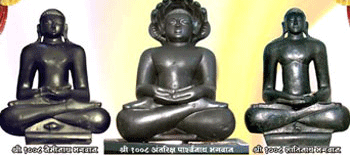
  Shri Digamber Jain Atishya Kshetra Nemgiri  is a very ancient digambar jain Atishya Kshetra 3 kilometers from Jintur,  There are two hills Nemgiri and Chandragiri famous for their ancient artistic and miraculous Jain Cave Temples and Chaityalayas. At Nemgiri Hill, in Cave Number 5 a miraculous idol of Lord Antariksha Parsvanath is staying in the space 3 inches high from surface.

Main Temple :
Nemgiri Hill : There are seven Cave Temples on the Nemgiri hill. In the cave number 4, a 7.5 feet high beautiful idol of Baghwan  Neminath in cross legged seating posture  is installed. In the cave number 5 an idol of Antariksha Parsvanath nearly  6.5 feet in height with nine serpent hoods  head, installed.  
Chandragiri Hill – A Choubeesee carved on a flat rock is very artistic here, that includes great standing idols of Lord Shantinath, Kunthunath & Arahnath and this was installed in V.S. 1665.

Other Temples :
In first cave of Nemgiri, an  attractive idol of Baghwan  Mahavira 3.5 feet in height in cross legged seating posture is installed, This idol was installed in V.S. 1676.Near the temple an ancient feet images of Acharya Bhadrabahu are also located. 

 In second cave there is an ancient idol of Lord Adinath in state of meditation and penance.

 In third cave there is an attractive idol of Lord Shantinath, 6 feet in height in cross legged seating posture. 

 In sixth cave there is an ancient idol in standing posture with four heads in four directions

 In seventh cave there is a  very artistic standing  5.5 feet in height idol of Lord Bahubali,  

 There are also two more old temples in Jintur city where old and  ancient idols of the temples ruined by invaders are placed. 

History 
In ancient times Kshetra Nemgiri was famous as Jainpur, said to be developed in the time of Emperor, Amogh Varsha of Rashtrakut Family. At that time there were 14 Jain Temples. This Kshetra was destroyed by invaders and out of 14 temples only two temples are present. The name of Kshetra was changed to Jintu.  

In the year 1609 A.D. this Kshetra was reconstructed and developed by Shri Veer Sangavi of Bagherwal. It is said that Samavsharan of Lord Mahaveer came here. Also the Last Shrut Kevali Acharya Bhadrabahu with his 12000 scholars visited this place. The famous idol of Lord Parsvanath was also installed by them. The idol called Antariksha Parsvanath  is staying in the space 3 inches high from surface without any support

Location :
Shri Digamber Jain Atishya Kshetra Nemgiri Samsthan, Jintur
Place & Post – Jintur, Taluka – Jintur, Dist. – Parabhani (Maharashtra), Pin 431509 
Phone 02457 – 220113

Tuesday, 31 May 2011

May 31, 2011

Vani Temple


Saptashrungi or Saptashringi is a site of pilgrimage situated 60 kilometers from Nashik. According to Hindu tradition, the goddess Saptashrungi Nivasini dwells within the seven mountain peaks. (Sapta means seven and shrung means peaks.). Devotees visit this place in large numbers every day.

The legend
This temple is one among the 51 Shakti peethas located on the Indian subcontinent. The Devi is said be swayambhu (self-manifested) on a rock on the sheer face of a mountain. She is surrounded by seven (sapta in Sanskrit) peaks (shrungain Sanskrit), hence the name: Sapta Shrungi Mata (mother of the seven peaks).

The image of the Devi is huge — about 10 feet tall with 18 hands, holding weapons like:
String of Beads Battle Axe, Mace, Arrow, Thunderbolt, Lotus, Bow, Water Pot, Cudgel, Lance, Sword, Shield, Conch, Bell, Wine Cup, Trident, Noose, Sudarsana Chakra.

The idol is always coated with sindoor, which is considered auspicious in this region. She is also known as Mahishasur Mardini, the slayer of the demon Mahishasur, who took the form of a buffalo. At the foot of the hill, from where one starts climbing the steps, there is the head of a buffalo, made in stone which is believed to be a demon.

Mahishasur Mandir
It is believed that the Devi Mahatmya, a sacred book which extols the greatness of Devi and her exploits, was composed at this place by the sage Markandeya. He performed rigorous penance on a hill opposite the one where the Devi resides; it is now named after him. The temple, which is on the side of the cliff, is 1230 meters above sea level. There is an old path with steps cut out of the mountain, which starts right at the foothills at Vani and goes all the way to the mountain.

How to Reach :
It is located in Nanduri, Tal:-Kalwan a small village near Nashik in India. A motorable road has been built, which goes up to an altitude of 1150 meters. From this place one has to climb around 500 steps to reach the shrine, which takes about 45 minutes.
May 31, 2011

Tryambakeshwar Temple


Trimbakeshwar or Trambakeshwar is an ancient Hindu temple in the town of Trimbak, in the Nashik District of Maharashtra, India, 28 km from the city of Nashik GPS Reference 20.021944 N, 73.729935 E. It is dedicated to Lord Shiva and is one of the twelve Jyotirlingas.

It is located at the source of the Godavari River, the longest river in peninsular India. The Godavari River, which is considered sacred within Hinduism, originates from Bramhagiri mountains and meets the sea near Rajahmudry. Kusavarta, a kund is considered the symbolic origin of the river Godavari, and revered by Hindus as a sacred bathing place.

Jyotirlinga :
As per Shiv Mahapuran, once Brahma (the Hindu God of creation) and Vishnu (the Hindu God of saving) had an argument in terms of supremacy of creation. To test them, Shiva pierced the three worlds as a huge endless pillar of light, the jyotirlinga. Vishnu and Brahma split their ways to downwards and upwards respectively to find the end of the light in either directions. Brahma lied that he found out the end, while Vishnu conceded his defeat. Shiva appeared as a second pillar of light and cursed Brahma that he would have no place in ceremonies while Vishnu would be worshipped till the end of eternity. The jyotirlinga is the supreme partless reality, out of which Shiva partly appears. The jyothirlinga shrines, thus are places where Shiva appeared as a fiery column of light. Originally there were believed to be 64 jyothirlingas while 12 of them are considered to be very auspicious and holy. Each of the twelve jyothirlinga sites take the name of the presiding deity - each considered different manifestation of Shiva. At all these sites, the primary image is lingam representing the beginningless and endless Stambha pillar, symbolizing the infinite nature of Shiva. The twelve jyothirlinga are Somnath in Gujarat, Mallikarjuna at Srisailam in Andra Pradesh, Mahakaleswar at Ujjain in Madhya Pradesh, Omkareshwar in Madhya Pradesh, Kedarnath in Himalayas, Bhimashankar in Maharastra, Viswanath at Varanasi in Uttar Pradesh, Triambakeshwar in Maharastra, Vaidyanath at Deogarh in Jharkand, Nageswar at Dwarka in Gujarat, Rameshwar at Rameswaram in Tamil Nadu and Grishneshwar at Aurangabad in Maharastra.

Shri Nilambika/Dattatreya/Matamba Temple
This temple is on top of the Neel mountain. All goddesses ('Matamba','Renuka','Mananmba') came here to see 'Parashuram' when he was performing penance (tapas). After his penance he requested all goddesses to stay there and the temple was formed for these goddesses. God Dattatreya दत्तात्रेय (Shripad Shrivallabh) stayed here for some years.

Do Visit